
Planning industrial cleaning requires more than setting a timetable. Facility managers need to coordinate cleaning tasks with production schedules, equipment access, material movement and site-specific safety procedures. A well-defined plan establishes which areas need attention, when they can be accessed, who is responsible and how completed work will be checked.
For factories, warehouses and other operational facilities, the objective is to fit cleaning into the working environment without creating avoidable interruptions or overlooking important tasks.
This guide explains how to assess cleaning priorities, choose suitable work windows and maintain a practical cleaning plan as operational requirements change.
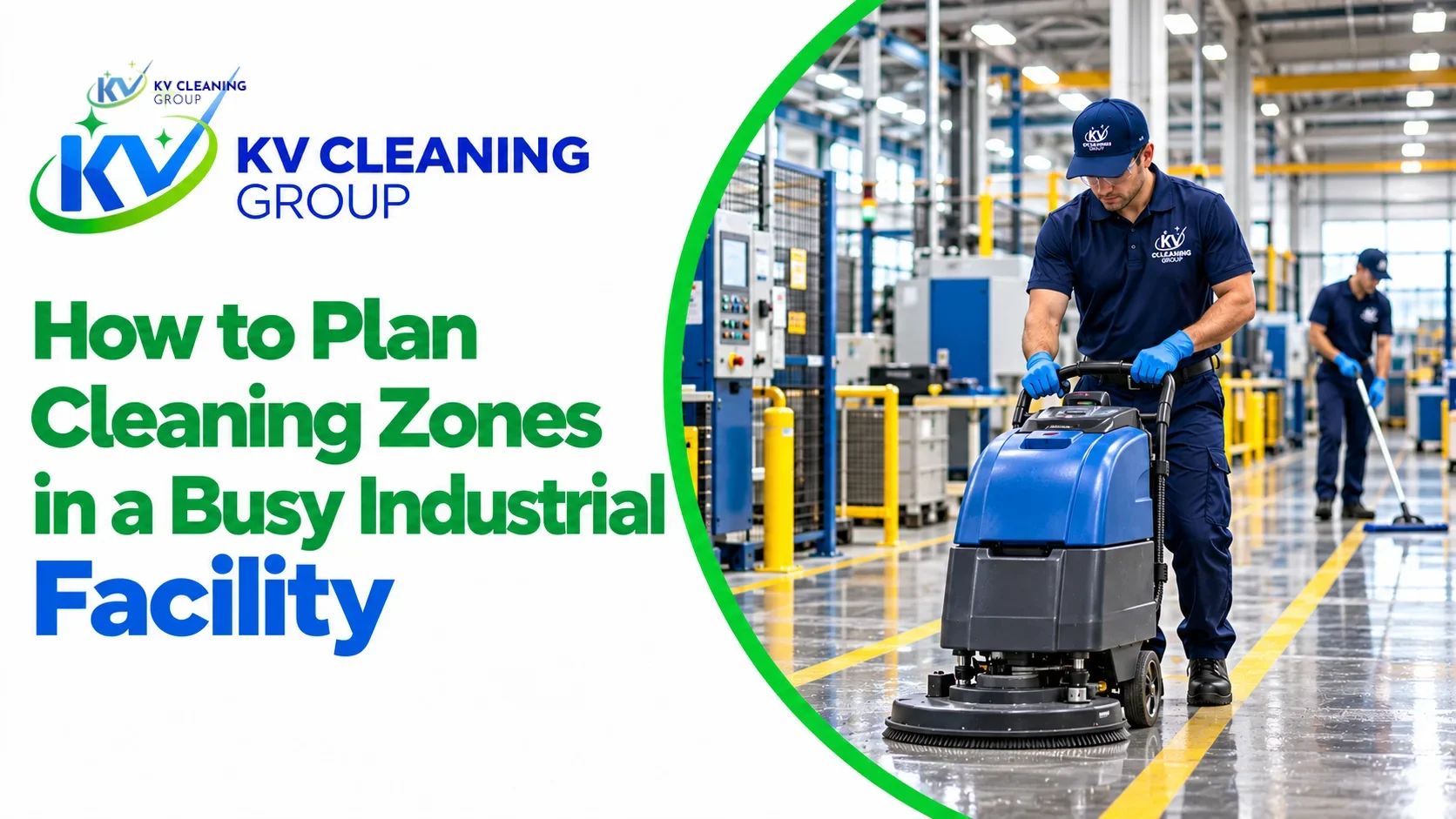
Begin by dividing the facility into clearly defined zones. This makes it easier to assign tasks, identify access restrictions and determine how frequently each area needs attention.
The assessment should reflect how each space is used rather than treating the entire building as one cleaning area.
Consider the following examples:
Production zones: Accessible surfaces and floors within the authorised cleaning scope.
Warehouse aisles: Areas affected by stock movement, vehicle traffic and accumulated debris.
Loading areas: Designated spaces used for receiving, dispatch and material handling.
Workshops: Approved work surfaces and surrounding areas that accumulate dust or residue.
Staff facilities: Shared amenities that require a separate cleaning routine.
Storage areas: Accessible floors and agreed external surfaces.
Elevated areas: Locations that may require specialist access equipment and additional risk assessment.
Record the boundaries of each zone and identify areas that require permission before entry. Machinery interiors, maintenance work and restricted production spaces should not be included unless they are specifically authorised and covered by appropriate procedures.
The appropriate cleaning method depends on the surface material, the type of contamination and the conditions in which the task will be performed.
Fine dust, loose packaging, oil residue and tracked-in dirt can require different approaches. Using the same method throughout a facility may be ineffective or unsuitable for certain surfaces.
Before selecting a method, assess:
The surface material and its condition.
The type and extent of contamination.
The availability of suitable cleaning equipment.
Product compatibility and manufacturer instructions.
Nearby machinery, electrical equipment and drainage.
The potential for moisture, residue or cleaning products to create additional hazards.
Whether specialist knowledge or equipment is required.
Where necessary, test the proposed method in a suitable area before proceeding. If the substance is unidentified or potentially hazardous, obtain appropriate advice rather than treating it as ordinary dirt.
The findings should be recorded in the cleaning plan so that the same approved method can be followed consistently.
Cleaning tasks should be scheduled according to the facility's actual operating pattern. A timetable that ignores production peaks, deliveries or shift changes may create access conflicts and lead to incomplete work.
Use this process to establish suitable cleaning windows.
Map operational activity. Record production hours, delivery periods, shift changes and planned maintenance.
Identify available access periods. Determine when each zone can be cleaned without conflicting with essential operations.
Confirm permissions. Establish who authorises access and whether inductions, permits or escorts are necessary.
Sequence the work. Arrange tasks so that completed areas can be released safely and other activities can continue where permitted.
Notify affected teams. Communicate the schedule and any temporary access restrictions.
Plan for changes. Establish how priority tasks will be rescheduled if production overruns or an area becomes unavailable.
Cleaning after hours may provide additional access opportunities, but it is not automatically the best option. Lighting, security, supervision, emergency arrangements and the availability of authorised personnel must also be considered.
Before work begins, identify the hazards associated with each cleaning zone and confirm the controls required by the facility.
Depending on the workplace, these may involve moving machinery, electrical equipment, hazardous chemicals, hot surfaces, vehicle routes or restricted access areas.
The site plan should clarify:
Which areas are authorised for cleaning.
Whether equipment must be stopped or isolated under an approved procedure.
Who is authorised to perform any required isolation.
Whether task-specific risk assessments or permits are necessary.
Which personal protective equipment and access equipment are required.
How unexpected spills, contamination or damage must be reported.
Which tasks must be referred to maintenance staff or a specialist contractor.
Cleaning personnel should not operate, dismantle or enter machinery beyond their training and authorisation.
When hazardous cleaning chemicals are involved, consult the product label and current safety data sheet (SDS). These documents provide information about chemical hazards, safe handling, storage, exposure controls and emergency procedures.
Refer to SafeWork NSW's hazardous chemical guidance for relevant workplace information.
Never mix cleaning products unless the manufacturer's instructions and an appropriate authorised procedure explicitly permit it. Unknown industrial residues should be assessed before selecting a product or deciding how the material should be handled.
A useful cleaning schedule specifies what must be done, where the work will occur, how frequently it should be completed and who is responsible.
The following table is a planning template, not a universal cleaning standard. Adapt it to the facility's actual conditions and requirements.
|
Work zone |
Planned task |
Scheduling consideration |
Completion record |
|
Pedestrian routes |
Remove accessible debris and clean agreed surfaces |
Foot traffic and workplace risks |
Inspection result and reported issues |
|
Warehouse aisles |
Clean authorised sections |
Stock movement and vehicle access |
Sections completed |
|
Loading areas |
Clean designated accessible surfaces |
Delivery and dispatch windows |
Area checked |
|
Production surroundings |
Clean approved external surfaces |
Production activity and equipment restrictions |
Completed tasks and exceptions |
|
Staff facilities |
Complete agreed cleaning tasks |
Usage and hygiene requirements |
Checklist record |
|
Storage areas |
Maintain accessible floors and surfaces |
Accumulation and access limitations |
Inspection result |
|
Periodic work zones |
Complete additional approved tasks |
Maintenance plan and suitable access |
Work record |
Assigning responsibility is as important as defining the task. The schedule should identify who completes the work, who verifies it and who must be informed if a task cannot be finished.
Any proposed cleaning frequency should be based on actual site conditions, contamination, operational needs, risk assessments and applicable requirements.
There is no single cleaning frequency suitable for every industrial environment. A high-traffic loading area may need attention more frequently than a storage area that is rarely accessed.
Review the following factors when deciding how often a task should be performed:
Traffic levels: How often workers, vehicles or materials pass through the area.
Contamination patterns: How quickly dirt, dust or residue accumulates.
Operational risks: Whether a condition requires immediate attention or additional controls.
Surface requirements: Whether the material needs a specific cleaning method.
Access availability: When the area can be reached safely.
Previous inspection results: Whether the current schedule leaves recurring problems unresolved.
Use inspection records to determine whether the schedule is working. If an area repeatedly needs unplanned cleaning, investigate the cause rather than automatically adding more routine tasks.
The underlying issue may be a recurring source of debris, a change in production activity or an unsuitable cleaning window.
A consistent inspection process helps identify missed tasks, recurring problems and areas that could not be accessed.
After a scheduled clean, the responsible person should:
Confirm which tasks were completed.
Inspect the agreed surfaces and accessible areas.
Record visible debris, remaining residue or missed sections.
Document any access restrictions that prevented completion.
Report hazards or damage through the site's established procedure.
Assign corrective actions where necessary.
Review repeated issues and update the plan when appropriate.
Use the same inspection criteria for each review. This makes it easier to compare results across shifts or work zones.
Photographs can help document particular issues where workplace policies and site permissions allow them. Records should accurately reflect the work performed; inaccessible or unfinished tasks should not be marked as complete.
A cleaning schedule should be reviewed whenever changes to the facility affect the work required or the conditions under which it can be performed.
Review the plan after changes such as:
Installation or relocation of machinery.
Changes to production processes or materials.
Altered delivery schedules or stock movement.
Renovation, repair or maintenance work.
Recurring spills, residue or debris accumulation.
Changes to chemical use or workplace safety procedures.
Discuss the changes with the relevant supervisor, update the affected tasks and confirm any new access arrangements before the revised plan takes effect.
Keep the previous records where appropriate so that recurring issues and changes in cleaning requirements can be identified over time.
External assistance may be appropriate when a facility has extensive floor areas, recurring contamination, specialised cleaning requirements or tasks that exceed its available equipment and expertise.
Before discussing a proposed scope, prepare the facility's approximate size, surface types, operational hours, priority areas, known contamination and access restrictions. Clarify which tasks are included, what requires separate authorisation and how completion will be documented.
For facilities considering external support, KV Cleaning Group's industrial cleaning services in Sydney provides the relevant service information. Confirm the required scope and service availability directly with the provider.
Effective industrial cleaning planning depends on understanding how a facility operates. Clearly defined work zones, suitable cleaning methods, agreed access windows and consistent inspection records make it easier to manage the work and identify where changes are needed.
Review the plan whenever production, equipment or site conditions change. A schedule based on the facility's actual requirements is more useful than a fixed routine that does not reflect how the workplace is used.
Start with the facility layout, work zones, surface types, contamination patterns, operating hours, access restrictions and relevant safety procedures. Use this information to define tasks, responsibilities, frequencies and inspection requirements.
Map the activities and access requirements of each shift, then agree on suitable cleaning windows with the relevant supervisors. Document handovers, temporary restrictions and arrangements for tasks that cannot be completed during the planned period.
Record why access was unavailable, notify the responsible supervisor and determine when the task can be completed safely. Update the schedule and completion record rather than marking the task as finished.
Consider specialist assistance when the task involves unidentified or potentially hazardous contamination, restricted machinery, elevated access, specialised equipment or requirements beyond the worker's training and authorisation. Follow the facility's established safety and escalation procedures.
Review inspection records, recurring contamination, missed tasks, access conflicts and unplanned cleaning requests. Use those findings to adjust task frequency, cleaning methods or scheduling arrangements where necessary.

Put these commercial cleaning insights into practice with KV Office Cleaning Sydney Group. Get a customised proposal tailored to your workplace layout and schedule.
From regular office maintenance to specialised carpet steam extraction and internal window washing, our experienced supervisors will build an agreed routine around your business hours.
Tell us about your workplace, the areas requiring attention, and your preferred service schedule.
Level 2, Suite 239/65-71 Belmore Rd, Randwick NSW 2031, Australia
Phone: +61 485 961 400 View on Google Business Profile
85 Metella Rd, Toongabbie NSW 2146, Australia
Phone: +61 2 8530 7001
View on Google Business Profile
43 The Avenue, Granville NSW 2142, Australia
Phone: +61 2 8530 7001
View on Google Business Profile
Level 4/110 George St, Parramatta NSW 2150, Australia
Phone: +61 485 961 400
View on Google Business Profile
7 Sarsfield St, Blacktown NSW 2148, Australia
Phone: +61 485 961 400
View on Google Business Profile
154 O'Riordan St, Mascot NSW 2020, Australia
Phone: +61 485 961 400
View on Google Business Profile
42 Anderson St, Chatswood NSW 2067, Australia
Phone: +61 485 961 400
View on Google Business Profile